
AlphaNet Technical Whitepaper: Automated Trading System Architecture
AI Quantitative Trading, Deep Learning, Risk Control and Algorithmic Execution
This technical whitepaper explains AlphaNet's automated trading system architecture: an AI quantitative trading framework that combines an AI DEX, high-dimensional alpha generation, deep learning models, overfitting controls, market-regime adaptation and algorithmic order execution.
A. Motivation – The Edge Gap
I. Evisceration of Retail Edge
Before we get into what AlphaNet is and what its AI DEX intends to solve, we will need to get into the overview of the motivation.
The evolution of the cryptocurrency market has shifted from an inefficient, retail-dominated "Wild West" to a highly sophisticated, institutionalized financial battleground. While the low barrier to entry makes it feel accessible, the barrier to profitability has risen exponentially. In a zero-sum game (and negative-sum after fees), for you to win, someone else usually has to lose. Below is an argument detailing why retail traders are structurally disadvantaged against market participants who treat extraction of value as a science, not a gamble.
1. The Information Asymmetry (The "News" Gap)
Retail traders typically operate on lagging information, whereas institutions operate on leading indicators and privileged access.
The Retail Feed: By the time a narrative reaches Twitter (X), Telegram, or a news outlet, the price move has usually already happened. Retail is often the "exit liquidity" for insiders who bought weeks prior.
The Institutional Feed:
Alternative Data: Hedge funds scrape GitHub repositories for developer activity, track wallet associations via proprietary software (Chainalysis/Nansen Enterprise), and monitor social sentiment using NLP (Natural Language Processing) algorithms before a trend trends.
Insider Access: VCs and Market Makers often have direct lines to protocol founders. They know about unlock schedules, delays, or partnerships before they are public.
2. The Technological Chasm (Speed & Execution)
For traders with short time horizons (scalpers/day traders), speed, execution, and short-timeframe data processing is the only metric that matters. Retail is fighting a war with a wooden stick against a machine gun.
Latency and Co-location
Retail: You click "Buy" on a web interface or mobile app. Your request travels over standard internet to the exchange's server.
HFTs (High-Frequency Traders): They use Co-location. Their servers are physically located in the same cloud cluster or data center as the exchange's matching engine. They see the order book updates before you do. Their low latency machine learning prediction algos and algorithmic execution layer on an additional edge on top of that.
MEV (Maximal Extractable Value)
On decentralized exchanges (DEXs), retail is constantly predated upon by bots.
- The Sandwich Attack: If you place a large buy order with high slippage tolerance, a bot detects it in the "mempool" (the waiting area for transactions). The bot buys immediately before you (pushing the price up), lets your buy order execute (pushing price up further), and then sells immediately after you. You get a worse price; they profit risk-free.
3. The Fee and Liquidity Trap
The cost of doing business is significantly higher for retail, which erodes edge over time.
| Feature | Retail Trader | Market Maker / VIP Fund |
|---|---|---|
| Trading Fees | Pays ~0.03% to 0.10% per trade taker, and ~0.07~0.03 maker | Often pays 0% or gets paid rebates (maker rebates) to provide liquidity. |
| Funding Rates | Often pays funding to keep leveraged positions open. | Often collects funding by hedging spot vs. futures (Cash and Carry). |
| Slippage | High impact on execution (loses money entering/exiting). | Sophisticated execution algos (TWAP/VWAP) to minimize impact. |
The Math of Ruin: A retail scalper aiming for small wins must overcome a massive hurdle rate (fees + spread). An institution paying zero fees can be profitable on price moves that would be a net loss for retail.
4. Algorithmic Predation & Market Structure
Institutions do not just predict the market; they structure it to trigger retail behavior.
Quant Models: Quantitative funds use statistical arbitrage and mean reversion models. They don't care about the "tech" or the "community." If a coin deviates mathematically from its correlation with Bitcoin or Ethereum, they short/long it instantly until it realigns. They have top talent, ample compute, and accumulated technology that makes mining alpha efficient and scalable.
Stop Hunting: Whales and algorithms can see "liquidity clusters" (where retail traders place their Stop Losses). They can push the price momentarily into these zones to trigger forced selling (liquidations), absorbing that cheap liquidity before the price reverses.
Wash Trading: On unregulated exchanges or low-cap coins, volume is often faked to lure retail into thinking there is organic interest (FOMO).
5. The Psychological Disadvantage
Perhaps the biggest edge institutions have is the removal of human emotion.
Retail: Vulnerable to FOMO (Fear Of Missing Out), FUD (Fear, Uncertainty, and Doubt), revenge trading, and sunk cost fallacy. Retail traders often cut winners early and let losers run.
The Algorithm: A Python script has no serotonin or dopamine. It executes based on strict logic. If a trade hits invalidation, it cuts it immediately. If a setup isn't present, it does not trade.
Comparison of Edge by Time Horizon
Scalping (Seconds/Minutes): Retail Edge: Near 0%. You cannot beat HFT latency and fee structures.
Swing Trading (Days/Weeks): Retail Edge: Low. You are susceptible to "wicks" designed to liquidate leverage, though you have a better chance here than scalping. You do not have the systematic consistency and robustness of high caliber quant models.
Investing (Months/Years): Retail Edge: Moderate. This is the only area where retail has a fighting chance. By having a longer time horizon than the monthly reporting requirement of a hedge fund, retail can ride out volatility that might force a fund to de-risk.
Summary
The gap is not just skill; it is structural.
Information: They know before you, more than you.
Speed: They act before you.
Cost: They pay less (or get paid) to trade.
Alpha: Better models, better algos, proprietary knowhow.
Capital: They have the depth to absorb variance; you do not.
II. Institutional Advantages – A Deeper Look by Participant
As you will shortly see as you continue reading – the goal of the AlphaNet AI DEX is to provide user the same level of access to the edges that institutional players have – so first let’s further do a deep dive into the types of market participants the retail trader is up against.
The structural disadvantage retail traders face is not just about "skill"; it is about access, infrastructure, accumulated knowhow and cost basis. Here is a structured summary of the specific edges held by the four major institutional participants:
1. HFT Market Makers (The "Speed & Cost" Edge)
These firms (e.g., Wintermute, Jump Trading) provide liquidity to exchanges. They don't bet on price direction; they bet on the spread.
Zero or Negative Fees (Rebates):
Retail: You pay ~0.05% - 0.1% per trade (Taker fee). To break even, price must move in your favor by at least that amount.
The Edge: HFTs often pay -0.01% to -0.02% (Maker Rebates). Exchanges pay them to place limit orders. They can buy Bitcoin at $95,000 and sell it at $95,000 and still make a profit purely from the fee rebate. Retail loses money on that same trade.
Co-Location (Latency):
Retail: Your order travels via standard fiber optic cables from your home/office to the exchange server (50–200 milliseconds).
The Edge: HFT servers are often physically located in the same location as the exchange's matching engine (Cross-connects). They receive market data and execute trades in microseconds. If price moves on Binance, they can arbitrage it on Coinbase before your screen even refreshes.
Order Book Visibility:
- The Edge: They use proprietary algorithms to detect "iceberg orders" (large orders hidden as small ones) and "spoof" the order book (placing fake buy walls to bait retail into buying, then canceling them instantly).
2. Quant Funds (The "Data & Probability" Edge)
These funds use machine learning and mathematical models to find inefficiencies that are invisible to the human eye, many are now using deep learning + AI to further the edge.
Statistical Arbitrage (Stat Arb):
Retail: You look for patterns like "Head and Shoulders" or "Support Levels."
The Edge: Quants track the correlation of thousands of coin pairs simultaneously. A dumbed down example: if ETH usually moves 2% when BTC moves 1%, but today it only moved 1.8%, their bots instantly buy the 0.2% deviation, knowing it will mathematically revert to the mean. They win on thousands of tiny trades where the probability is 51% in their favor.
Systematic Directional Trading (includes trend following)
Retail: Follow trends when they become apparent, then to get easily “whiplashed” due to the market being relatively efficient
The Edge: Quants can build models that consider over hundreds of data points in nonlinear logic to generate profitable signals that even the most sophisticated professional retail traders would not be able to create.
Alternative Data Pipelines:
Retail: You rely on news headlines or public charts.
The Edge: Quant funds pay for expensive "Alt Data" feeds:
Satellite Imagery: Monitoring energy usage at mining centers.
Wallet Tracking: Real-time alerts when specific "smart money" wallets move funds.
Sentiment Analysis: NLP (Natural Language Processing) bots that scrape Twitter/Telegram/Discord to quantify "hype" and front-run retail FOMO.
3. Whales (The "Capital & Psychology" Edge)
High-net-worth individuals or entities that hold enough supply to dictate price action.
Stop Hunting (Liquidity Harvesting):
Retail: You place a logical Stop Loss below a support level.
The Edge: Whales can see "Liquidity Clusters" (zones where thousands of retail stops are sitting). They use their capital to aggressively sell, pushing price just low enough to trigger your stops (forcing you to sell). They then buy back your cheaper coins, absorbing your liquidity to fuel the next leg up.
Cost Basis Advantage:
- The Edge: Whales often accumulated their positions years ago or via OTC (Over-The-Counter) desks. Because they don't buy on the open spot market, their large purchases don't spike the price immediately—until they want to pump it.
Market Moving:
- The Edge: In low-liquidity coins, a whale can simply "paint the chart." They can buy their own sell orders (wash trading) to create the illusion of high volume, tricking retail trend-following bots and traders into entering.
4. Information Insiders (The "Time Travel" Edge)
VCs, Exchange Employees, and Protocol Founders who have material non-public information.
Private Round Access:
Retail: You buy a token at "Public Launch" price (e.g., $1.00).
The Edge: Insiders bought via SAFTs (Simple Agreement for Future Tokens) months prior at $0.05 or $0.10. Even if the token drops 80% from launch, they are still up 200%, meaning they can dump on you profitably while you are taking a massive loss.
Unlock Schedule Knowledge:
- The Edge: Insiders know the exact second millions of locked tokens will vest and become tradable. They can front-run this inflation by opening short positions or selling their liquid stake days before the unlock floods the market.
Exchange Listing Alpha:
- The Edge: Getting listed on a Tier 1 exchange (Binance/Coinbase) usually pumps a token. Insiders often know about these listings weeks in advance (despite NDA attempts) and accumulate the token on decentralized exchanges (DEXs) before the announcement is made.
Summary of Edge
| Participant | Primary Edge | Can Retail Compete? |
|---|---|---|
| HFTs | Speed & Rebates (Negative fees) | No. You cannot beat physics or negative costs. |
| Quants | Data, Models, and Machines (Probability) | No. You cannot manually process that much data, train that many models, have that robust of a systematic pipeline |
| Whales | Capital (Moving the market) | No. You lack the funds to absorb variance. |
| Insiders | Information (Knowing the future) | No. You are legally/structurally outside the circle. |
B. AlphaNet AI DEX: An Automated Crypto Trading System
Now just what if, retail traders and professional solo-traders had access to one-of-a-kind, cutting-edge Quantitative AI Platform, the dynamic would shift from "gambling against the house" to "using a counter-strategy." While retail and individual professional traders cannot physically beat the speed of HFT market makers or the insider knowledge of founders (access), an AI platform levels the playing field by solving the Execution and Data Processing, Proprietary Models & Systems, Compute Resource gaps.
This section will provide an layman-as-possible executive summary of how AlphaNet delivers and transforms traders’ alpha and trading edge – for those craving a technical deepdive, read the next section.
I. Removing Weaknesses
A quantitative AI trading platform removes the three biggest retail weaknesses:
Processing Power: A human can watch a few charts and use their favorite indicators, newsfeeds, and on-chain analytics; a robust low-latency machine learning pipeline can process and predict using hundreds or thousands of data points per second, depending on the model.
Emotion: Such a system never "revenge trades" or "holds a loser" because of hope. It executes logic ruthlessly according to signals, risk models, and model-determined exit thresholds.
Execution Skill & Speed: While the goal is not to match HFT market makers in speed, a robust deep learning-based execution algorithm breaks down “parent orders” and splits trades in milliseconds (100–300ms) and helps minimize slippage and trading costs. (More technical details in AI systems section)
In the next section in this paper, we will also explain why we refer to deep learning as AI rather than the ever so popular generative AI (LLM).
II. Deep Learning Systems: Institutional Power, Retail Control
For a research comparison of deep-learning systems and systematic alpha mining, read Deep Learning for Algorithmic Trading vs Systematic Alpha Mining.
Below will give you a basic idea of how AlphaNet provides, optimizes, and retains edge for traders through its core offerings and design principles.
1. The "Brain": Deep Learning & Multi-Factor Analysis
Simple trading bots that most existing automated trading platforms follow linear rules via technical indicators ("If price crosses moving average, buy"). AlphaNet utilizes Deep Learning (DL) models trained on years of granular historical data and inferenced on real-time data.
Instead of looking at a single chart, the AI evaluates hundreds or thousands of factors (features) in real-time to construct a probability map of future price action.
The Input Layer (the data):
Market Data: Price, volume, and derivations of price & volume that provide additional information (volatility, ranges, trends, patterns, entropy, etc)
Market Microstructure: Order book imbalance, bid-ask spread velocity, trade size clusters.
Derivatives Data: Funding rate anomalies, open interest changes, liquidation heatmaps.
Cross-Correlations: How BTC moves relative to ETH, stablecoin dominance, and legacy market correlations (SPX/NDX).
On-Chain Signals: Exchange inflow/outflow, whale wallet activation.
The Output: The AI does not "guess." It assigns a confidence score (e.g., 84.2% probability of upward variance in the next 4 blocks) or a return prediction (typically log[return] of price of a particular time horizon: 15m, 1H, 2H etc) based on how these hundreds of factors interact non-linearly.
2. The Strategies: High-Dimensional Alpha
Because the underlying engine uses deep learning, the specific DL versions of strategies are far more potent than discretionary retail approaches or those of commercial "trading bots".
Microtrend Strategy
Timeframe: Average few hours to days
Goal: Capture sustained moves (trends) that last long enough to cover costs and generate profit, but are too short for macro-investors to crowd out.
The Traditional Flaw: Technical indicators are "lagging." They only tell you a trend has started after the price has already moved significantly. You enter late and exit late, eating into your margins.
The Deep Learning Optimization:
Feature Extraction: Instead of just price, a DL model (like an LSTM or Transformer as used in AlphaNet) ingests price, volume, order book imbalance, and potentially alternative data (depending on the strategy) simultaneously.2
Sequence Modeling: It looks at the entire sequence of recent data to recognize the "shape" of a trend formation before a moving average would cross over.
Edge Optimizer: Early Entry & False Breakout Filtering.
- Simple Explanation: A traditional trader waits for a "green light" signal. The DL model acts like a pattern-matching expert who sees the tension building up to the green light. It can enter a trend 3-4 candles earlier than a Moving Average, and crucially, it can distinguish between a real trend start and a "fake out" by correlating hundreds of data points in non-linear fashion that a simple indicator would miss.
Single-Asset Mean Reversion
Timeframe: 30 min to hours
Goal: Bet that a price will snap back to a particular average point.
The Traditional Flaw: Traditional mean reversion uses approaches such as fixed bands (e.g., Bollinger Bands).4 In a strong crash (trending market), price hugs the band and keeps dropping. A traditional strategy keeps buying the dip and gets wiped out ("catching a falling knife").
The Deep Learning Optimization:
Regime Classification: A DL model (often a CNN or MLP) has a pre-model layer that classifies the market regime: "Are we chopping?" or "Are we crashing?"5
Dynamic Thresholds: If the regime layer detects a "Crash Regime," it disables the buy signal that the DL model outputs even if the price is low. It only enables mean reversion when it detects the volatility is stabilizing. This is referred to as “dynamic trading rules” (covered more in next section).
Edge Optimizer: Survival.
- Simple Explanation: Traditional mean reversion is like a rubber band; you bet it will snap back. But sometimes the rubber band breaks (market crash). Deep learning acts as a sensor that checks if the rubber band is about to break. If it is, it tells you not to trade. The edge isn't just making money; it's avoiding the one bad trade that ruins your month.
AI Leveraged Scalping
Timeframe: 10 to 30 min
Goal: Quick profits from small intraday moves, using leverage to amplify gains.
The Traditional Flaw: Standard scalping models or algos process data in "frames" (e.g., every 1 second). This creates two problems: lag (waiting for the frame to close) and computational noise (processing data even when nothing is happening).
The Spiking Neural Network (SNN) Optimization:
Event-Driven: For leveraged AI scalping strategies, AlphaNet uses mainly Spiking Neural Network (SNN) implementations. SNNs do not wait for a "time bar" to close. They only "fire" (activate) when a specific change in price (an event) occurs.
Noise Suppression: If the market is quiet, the SNN is silent. It only reacts to significant bursts of information.
The Edge Optimizer: Latency & Precision without HFT Infrastructure
Simple Explanation: Imagine a security guard watching a camera.
Traditional Systems: Looks at the screen every 1 second. If a thief runs by in 0.5 seconds, the AI might miss it or see a blur.
SNN: Is connected to a motion sensor. It reacts the instant a pixel changes.
For a retail trader, this means the system can react to sudden volatility spikes (for entry or emergency exit) much faster than a standard candle-based system, protecting your leveraged positions from sudden slippage.
3. Machine Learning Insight Models
Most retail traders obsess over "Signals" (Buy/Sell), but many institutional traders obsess over "Context" (Regime, Volatility, Liquidity). By providing non-signal contextual insights, the models act as "Market Meteorologists". It doesn't tell you where to drive the car (that's your trading style), but it tells you if it's raining, snowing, or sunny, so you know which tires to use and how fast to drive.
Here is how the main categories of ML-based insights that AlphaNet offers for traders to create a "Meta-Edge" and how users can pair them with their own styles.
Regime Detection (The "Terrain" Map)
The Problem: You are a trend trader, but the market enters a "chop" (sideways) regime. Your moving average strategy gets chewed up by false breakouts.
The ML Solution:
Tech: Uses Hidden Markov Models (HMMs), Unsupervised Learning (e.g., K-Means) to classify market states into discrete buckets: High-Vol Trend, Low-Vol Grind, Chop/Noise, Liquidation Cascade.
The Edge: The AI detects the regime shift before price confirms it. For example, it might see order book liquidity thinning out (a precursor to volatility) and switch the regime tag from "Stable" to "Fragile. There are various variation of regime models that measure different aspects of the market (trend, structural change, volatility, liquidity, macro, etc).
User Benefit: Use structural changes for optimal trading decision-making.
Volatility Prediction (The "Speed Limit")
The Problem: You use a fixed Stop Loss (e.g., $100). In low volatility, you get stopped out by noise; in high volatility, your stop is too tight.
The ML Solution:
Tech: Uses LSTMs (Long Short-Term Memory) networks that ingest not just price and volume variance, but option flows (Implied Volatility) and funding rates to forecast future volatility (RV).
The Edge: Better Risk-Adjusted Returns. The model predicts, "Volatility will expand, or continue to be high in the next hour."
User Benefit: You dynamically adjust your position size. If vol is high, you trade smaller size with wider stops. If vol is low, you trade larger size with tighter stops.
Multi-Time Horizon Trend Strength (The "Wind" Gauge)
The Problem: You are in a trade, and the trend slows down. You exit early, only to watch it rip higher.
The ML Solution:
Tech: Uses Transformer Models (like GPT, but for time-series) to analyze the "attention" of the market. It looks at volume velocity and trade frequency to measure the "health" of a trend.
The Edge: It differentiates between a "Reversal" (trend is dead) and a "Pullback" (trend is resting).
User Benefit: You hold winners longer ("Letting profits run") because the AI confirms the underlying trend structure is still intact.
4. The "Cockpit": Total Sovereignty and "Slice and Dice" Control
Crucially, this is not a "black box" where you deposit money and hope for the best. The platform is designed as a Force Multiplier for the trader. You are your own the Portfolio Manager; the robust pipeline that AlphaNet has built is your execution team.
Instant "Kill Switch" & Liquidity:
- Users maintain custody. You can stop any strategy, liquidate positions, and withdraw funds instantly. There are no lock-up periods typically associated with hedge funds.
"Slice and Dice" Customization:
Users can blend strategies to fit their specific market view.
Example: A user is bullish but expects volatility. They can allocate 70% to AI Microtrend (to catch the move) and 30% to AI Scalping (to profit from the noise along the way).
Flexible Trading Modes:
Manual Mode: The user trades using their own style, with the assistance of our AI Insight Models for contextual edge and algorithmic execution for minimized trade costs and slippage.
Autopilot: The user flexibly allocates capital to various AI strategies and let them run on autopilot mode, optimizing in between strategies.
AI Scalping: The user our AI scalping strategies (supports leverage) to use in semi-automated trading in short timeframes. This mode provides scalping traders optimized edge, PnL and win rate.
5. AI Algorithmic Execution
The AI Algo Execution feature transforms retail trading by replacing clumsy market orders with institutional-grade algorithmic logic, bridging the gap between retail and wholesale liquidity. Instead of executing trades instantly—which creates market impact and slippage—users can deploy TWAP (Time-Weighted Average Price), VWAP (Volume-Weighted Average Price), or Hybrid AI algorithms. These agents intelligently fragment orders, executing them over specific time horizons or high-volume windows to mask the trader's footprint. This precision not only eliminates toxic slippage but actively targets "negative slippage" (price improvement), using AI to capture micro-dips during execution to secure an entry price better than the market average at the start of the trade.
Crucially, this execution layer acts as a universal utility across the entire platform, functioning as the "invisible hand" for Standard (Manual) trading, Autopilot vaults, and AI Scalping strategies. Whether a manual trader wants to slowly accumulate a swing position without moving the price, or a scalping bot needs to exit thousands of micro-positions efficiently, the algo engine automates the entire process. This "set-and-forget" capability saves users hours of screen time while ensuring every trade—regardless of mode—is settled with the cost-efficiency of a top-tier quantitative fund.
Key Value Points:
Zero-Impact Entries: Uses "Iceberg" logic to hide large order sizes, preventing predatory front-running and MEV bots.
Price Improvement: dynamic routing seeks to capture the spread, turning execution costs into potential profit (negative slippage).
Universal Integration: A single execution layer that powers manual trades, passive investing, and active AI scalping alike.
6. Collective Self-Preservation of Alpha
A "Gatekeeping" mechanism functions as a digital immune system for the platform's core mission – alpha generation. In quantitative trading, alpha is a finite resource; every strategy has a "saturation point" (Capacity) where adding more capital dilutes returns for everyone due to slippage and market impact. Therefore, the platform enforces a strict "Alpha-to-Capital Equilibrium": user onboarding is algorithmically throttled so that Total Value Deployed (TVD) never exceeds the platform's direct ability to generate superior returns. Instead of the traditional "growth at all costs" model, this DEX prioritizes the preservation of edge for existing users, creating a "self-preserving collective" where membership is a privilege maintained by the platform's performance metrics, ensuring the "tragedy of the commons" never erodes the community's profits.
User Tiering & "Value-Created" Meritocracy
To determine who gets access to the scarcest high-alpha strategies, the platform replaces simple "volume tiers" with a comprehensive "Value Created" Score. This score identifies and rewards users who contribute to the ecosystem's health rather than just extracting from it.
Factors Determining User Tier:
Net Alpha Generated (PnL): Users who consistently trade profitably (proving they are using the tools well) are prioritized over reckless traders.
Total Value Deployed (TVD): The duration and size of capital active in "Autopilot" or "AI Scalping" vaults (distinct from simple TVL, this measures active participation).
Execution Efficiency: A score based on how often the user utilizes "low impact" execution tools (TWAP/VWAP) vs. toxic market orders that hurt the DEX's liquidity.
Ecosystem Longevity: Weighted seniority based on how long capital has been deployed without withdrawal (loyalty multiplier).
Marketing & Referral Value: Quantifiable attribution of new quality users brought to the platform.
Governance Participation: Activity rate in voting on strategy parameter updates or new model deployments.
7. Summary: The New Retail Paradigm
| Feature | Traditional Retail Bot | Deep Learning AI Perp DEX |
|---|---|---|
| Data Inputs | Price & volume-based indicators | Thousands of Factors (Market, Derivs, Order Book) |
| Logic | Hard-coded "If/Then" rules | Deep Neural Networks (Non-linear probability) |
| User Role | Passive / Helpless/ Limited | Active Commander (Slice & Dice strategies) |
| Flexibility | On or Off | Hybrid Modes (Manual, Autopilot & AI Scalping) |
| Result | Coin-flip probabilities | Institutional Probability Edge |
8. Institutional Partnerships – AlphaNet’s Technology Backbone
AlphaNet has partnered with a select few quantitative investment firms and prop trading firms across Asia in serving as the knowhow, infrastructure, and compute backbone of AlphaNet.
Namely, Tensor Investment is the main technology partner backing the strategies, algorithmic execution, and compute infrastructure behind AlphaNet’s AI DEX. Tensor is a multi-strategy prop firm that trades across a variety of instruments – including but not limited to crypto, fixed income, equity indexes, and commodity futures across a range of SOTA (state of the art) deep learning-based strategies that do not fit into the typical categories of trend following, mean reversion, or arbitrage.
Tensor’s compute arsenal contains over 1000+ high performance GPU nodes (A100/H100) and lightweight specialized edge nodes, and has a highly specialized team consisting of seasoned researchers from computer science, physics, computational biology, and mathematics backgrounds.
For more information, visit: https://www.tensorcorp.com/
C. Automated Trading System Architecture
I. Definition of "AI"
In systematic and quant trading, Generative AI (LLMs) and Deep Learning (DL) / Deep Reinforcement Learning (DRL) are fundamentally different tools with distinct structural objectives.
While LLMs are transforming discretionary research and sentiment analysis, they are largely unsuited for the core engine of a systematic, low-latency trading system.
1. The Fundamental Objective Mismatch
The primary reason lies in the loss function (what the model tries to optimize).
Generative AI (LLMs): The objective is Next-Token Prediction (minimizing cross-entropy loss). The model is probabilistic and designed to produce plausible-sounding text. It essentially asks, "What is the most likely next word?"
Deep Learning (DL): The objective is usually discriminative (minimizing Mean Squared Error or classification error). It asks, "What is the precise probability that the price moves up in the next 100ms? Or what is the prediction in change in price in the next 2 hours?". Deep Learning is used in building trading strategies that are time series and sequential in nature, and can be backtested with consistent results.
Deep Reinforcement Learning (DRL): The objective is Reward Maximization (e.g., maximizing Sharpe Ratio, PnL, or minimizing implementation shortfall). The model asks, "What action (Buy/Sell/Hold) will maximize my long-term cumulative reward?" Reinforcement learning models focus on action that maximize results for custom objective.
Why this matters: An LLM might write a convincing narrative about why a stock should go up, but it lacks the mathematical framework to optimize for risk-adjusted returns or handle the stochastic nature of market microstructure.
2. Latency: LLM Bottleneck
In low-latency and high-frequency trading (HFT), speed is the alpha.3
LLMs: Inference is massive. A typical frontier LLM requires meaningful GPU memory and computation time to generate a single token. Latency is measured in hundreds of milliseconds to seconds.
Traditional DL/DRL: A compact LSTM, MLP (Multi-Layer Perceptron), or CNN used for alpha signal generation can be highly optimized (pruned, quantized) to run on even edge devices and FPGAs or specialized ASICs. Inference latency can be optimized to milliseconds or single-digit milliseconds.
The Bottleneck: If a higher-frequency scalping strategy takes seconds to decide to buy, a good portion of the edge has likely already vanished.
3. Data Representation: Numerical Precision vs. Semantic Tokens
Market time-series data is fundamentally different from natural language.
The Tokenization Problem: LLMs process text tokens. To feed price data into an LLM, you must tokenize numbers (e.g., "100.50"). This destroys the continuous numerical relationships between values. The LLM sees "100" and "50" as tokens, not as a continuous differentiable quantity.
Deep Learning: Neural networks take raw floating-point tensors as input. They preserve the numerical precision required to detect micro-correlations in price, volume, and order book depth.
4. Robustness and Hallucination
Institutional systems prioritize reliability and safety over creativity.
Non-Determinism: LLMs are stochastic by design (Temperature > 0). If you feed the same market data into an LLM twice, you might get two different trade recommendations. Systematic trading requires deterministic, reproducible logic.
Hallucination: LLMs can "hallucinate" facts or invent rationale. In trading, a "hallucination" is a fat-finger error that can bankrupt a fund.
Deep Learning: While DL models can be "black boxes," they are deterministic during inference (with dropout disabled). You can mathematically bound their outputs and stress-test them effectively.
5. Summary - A Comparison
| Feature | Generative AI (LLMs) | Deep Learning / DRL |
|---|---|---|
| Core Task | Text/Content Generation | Pattern Recognition / Control |
| Input Data | Unstructured Text/Images | Structured Time-Series (Tick, OHLCV) |
| Inference Speed | Slow (ms to seconds) | Fast (microseconds) |
| Output Nature | Probabilistic, Creative | Deterministic, Precise |
| Risk | Hallucination, Inconsistency | Overfitting (but manageable) |
| Best Use Case | Sentiment Analysis, Parsing News | Execution, Alpha Signal, Risk Management |
The "Sweet Spot" for Generative AI in Quant
While LLMs don't trade, they are increasingly part of the Quant 2.0 workflow in supporting roles:
Sentiment Signal Generation: Reading Fed minutes, earnings call transcripts, or Reddit sentiment and converting it into a numerical score (0 to 1) that is then fed into a traditional Deep Learning model.
Coding Assistant: Helping quants write Python/C++ code for backtesting engines.
Data Cleaning: Parsing unstructured alternative data (e.g., shipping manifests, credit card transaction descriptions).
Factor/Feature Discovery: When your strategy pipeline runs out of ideas for factors to test, LLMs can be used to provide factor-generation ideas from raw data points (price, volume, LOB, OI, macro, etc)
II. Expanding Uncharted Territory – Deep Learning-Driven Quant Trading
While deep learning (DL) has conquered fields like computer vision and NLP, in quantitative trading it remains—as you intuitively noted—largely “partially charted territory or "uncharted territory" by industry design. This is not because the technology is immature, but because financial data is adversarial and the cost of a false positive is bankruptcy, not just a weirdly generated image.
Here is why "robust system design" in AI trading is so difficult, why there is no standard "playbook," and how the few institutional players who have solved it keep their methods locked down.
1. The "Trade Secret" Moat (Why there is no "ImageNet" for Finance)
In Tech (Google, Meta), publishing research attracts talent. In Finance, publishing research destroys alpha. If a fund discovers a specific DL architecture that successfully predicts volatility, publishing it would allow competitors to arbitrage the signal away within weeks.
Result: There is no shared community knowledge base. A "best practice" at Renaissance Technologies might be considered a "rookie mistake" at Two Sigma, and neither will ever know.
Contrast: In Computer Vision, everyone agrees that a ResNet or Transformer is the standard backbone. In Quant, there is zero consensus on whether to use LSTMs, Transformers, or simple MLPs.
2. The "Black Box" Trust Barrier (Adoption Lag)
Many successful traditional quant funds are run by physicists and statisticians who trust linear explanations.
Quant 2.0 (Traditional): A researcher discovers a factor (e.g., “Momentum”), makes the connection mathematically, and writes a linear regression model to trade it. If it breaks, they know why.
Quant 3.0 (Deep Learning): A model discovers a non-linear pattern involving price, volume, and time-of-day. If it suddenly starts selling heavily during a crash, the researcher often cannot explain why to the Risk Manager.
The Uncharted Problem: There lacks best practices and robust, standardized tools for Explainable AI (XAI) in markets and trading. Until a Risk Manager or CIO can “audit” a neural network’s decision systematically, most funds will not give it the keys to the execution engine.
3. Complexity and Massive Search Space
A central factor contributing to the "uncharted" nature of AI in quantitative finance is the sheer Complexity and Search Space of the problem. Unlike problems with fixed rules (like Chess) or static targets (like image recognition), the markets is a vast, continuously shifting landscape of possibilities. A trading system is not just a single model; it's a complex chain of dozens of interlocking decisions—from which 100 features to select out of thousands, to which neural architecture (LSTM, Transformer, N-BEATS) to use, down to the precise hyperparameters and the logic of the final execution engine. The number of possible permutations of a complete end-to-end system is effectively infinite.
This creates a massive computational bottleneck. To explore even a small fraction of this search space requires immense HPC (High-Performance Computing) resources to run thousands of simultaneous backtests, each with different configurations. Furthermore, the search is complicated by the need to build robust peripheral systems around the core model to handle explainability (interpreting why a "black box" made a decision in a specific regime) and overfitting mitigation (ensuring a strategy didn't just get lucky on past data).
Key aspects of this complexity include:
Combinatorial Explosion: The total search space is the product of all possible choices at every stage: (Feature Sets x Model Architectures x Hyperparameters x Regime Definitions x Execution Rules).
Non-Stationarity Tax: Because market rules change, a configuration that was optimal in 2020 might be disastrous in 2025, requiring constant, expensive re-searching and re-training.
The "Peripheral" Burden: Building the core Deep Learning model is often less than 20% of the work. The majority of the engineering effort goes into building the "scaffolding" that makes the model safe and explainable enough to be deployed with real capital.
III. AI Quantitative Trading System Design
[Don’t worry, this is a very hand-wavy overview that gives an idea of AlphaNet’s System Design, it does not disclose any of the hundreds of unique details, nor any core IP. No moat or edge will be lost due to this overview]
The overall structure of AlphaNet’s pipeline focuses on creating a never ending cycle of data processing, factor/feature discovery + evaluation, model selection, training iteration, alpha decay mitigation (will be explained in more detail in later section) and dynamism and optimal control in trading.
The rough flow can be demonstrated by this diagram:
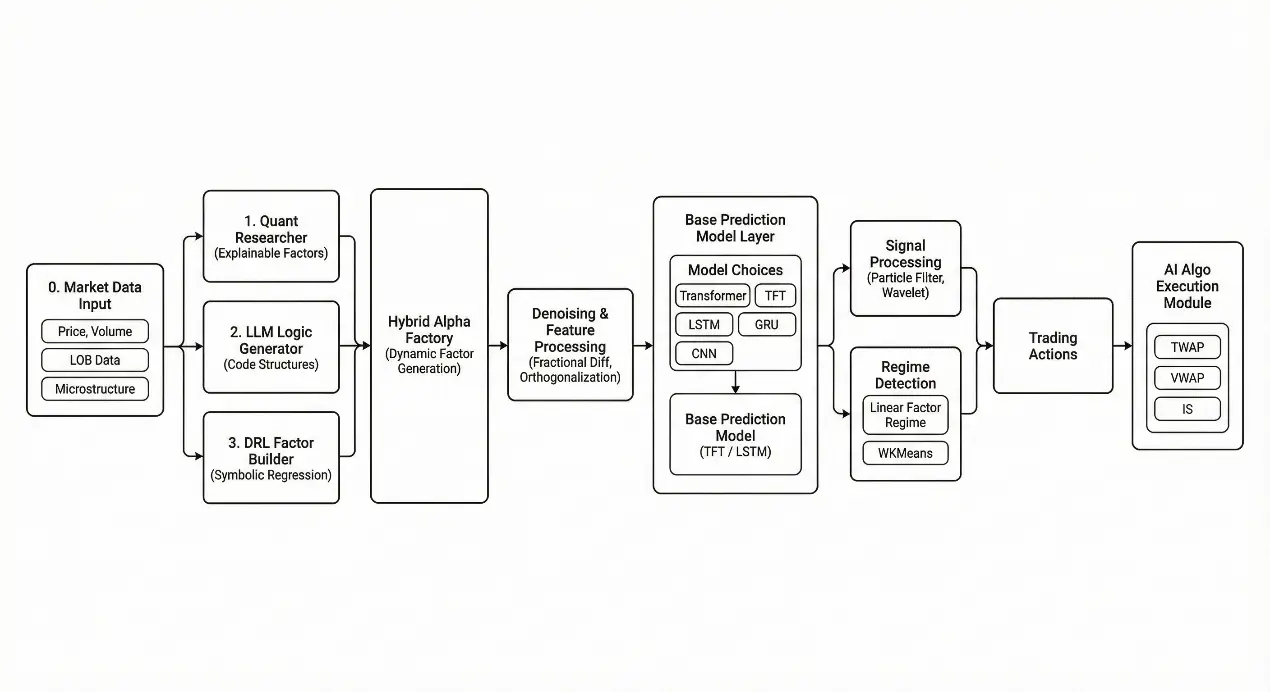
1. Phase 1: The Hybrid Alpha Factory (Dynamic Factor Generation)
For the methodology behind automated feature construction, see Systematic Feature & Factor Mining for Market Microstructure.
This module functions as a Symbolic Competition. The output of this phase is not a prediction, but a library of executable factors (mathematical formulas) that transform raw market data into alpha signals.
1. Quant Researcher (The "White Box" Anchor)
Role: Provides the "priors" based on economic theory and market microstructure.
Input: Raw LOB (Limit Order Book) data, Trade Tape.
Output: Explainable features.
Example: Order Flow Toxicity (VPIN). A researcher manually codes the logic to measure the ratio of volume executed by informed traders vs. noise traders.
Why it stays: These factors provide a stable baseline and prevent the model from learning spurious correlations that defy economic logic.
2. LLM as "Logic Generator" (The Symbolic Architect)
Mechanism: We use an LLM (e.g., Kimi K2 or specialized Deepseek Math V2) fine-tuned on mathematical operations and/or financial libraries (Pandas, Polars).
Prompt Engineering: "Generate a Python function using Polars that captures 'Liquidity Replenishment Rate' by comparing the rate of limit order adds vs. cancels at the Best Bid over a 50ms window."
Output: Syntactically correct Python/C++ code snippets representing new factors.
Value: The LLM acts as a high-speed junior researcher, translating abstract market concepts ("price momentum usually reverses when liquidity dries up") into executable code ((ask_vol - bid_vol) / rolling_std).
3. DRL-Driven Factor Construction (The "Builder")
State Space: The current set of valid factors and their correlation matrix.
Action Space (Discrete): A library of operations and operands.
Operands: Open, Close, Volume, Bid_Size_L1, Ask_Size_L1.
Operators: +, -, /, Delta(), Ts_Rank(), Log(), Decay().
The Process: The DRL agent builds a Computational Graph (syntax tree) step-by-step. Simple example:
Step 1: Select Close.
Step 2: Select - (Minus).
Step 3: Select Open.
Step 4: Select / (Divide).
Step 5: Select VWAP.
Reward Function: The Information Coefficient (IC) of the resulting factor, penalized by the complexity of the formula (parsimony principle). This avoids "bloated" factors that are just overfitted noise.
2. Phase 2: Denoising & Feature Processing
Fractional Differentiation: Preserving memory while ensuring stationarity.
Orthogonalization: Using PCA or QR decomposition to ensure the new DRL-generated factors add unique information and are not just linear combinations of the Quant Researcher's existing factors.
3. Phase 3: Model Selection (Base Prediction)
For preference-driven strategy evaluation and portfolio construction, read Agents for Trading Strategy Selection.
Core Architecture: Temporal Fusion Transformer (TFT), LSTM, GRU, or Transformer.
Role: Takes the 100+ inputs from Phase 1 (Quant + LLM + DRL factors) and outputs a probability distribution of returns over the next horizon (e.g., 5m, 1H, 2H, 4H etc).
4. Phase 4: Signal Generation & Control Mechanism
This module translates the noisy probabilities from Phase 3 into precise, robust trading actions.
Submodule A: Signal Processing (The Filter Layer)
We apply advanced filtering to separate the "True State" of the signal from market noise.
Wavelet Transformation: Decomposing the signal into different frequency components (removing high-frequency jitter while keeping the trend).
Exponential Smoothing: Standard EWMA for baseline trend following.
Particle Filtering (Sequential Monte Carlo): [New Addition]
Concept: Unlike a Kalman filter (which assumes Gaussian noise), a Particle Filter assumes the market is non-linear and non-Gaussian.
Mechanism: The system generates X number of "Particles" (hypothetical states of the true signal). As new price data arrives, particles that align with the data are re-sampled (survive), and those that drift are discarded.
Result: A probability density function of the true signal value. This allows the system to say: "The model predicts Up, but the particle dispersion is huge, so the signal quality is low. Do not trade."
Submodule B: Dynamic Trading Rules (The Decision Layer)
How do we implement the trade given the current environment?
1. Regime Detection via WKMeans (Wasserstein K-Means), HMM, and Linear Regimes
Implementation: We cluster market states by different types of regime models (Volatility, Volume, Spread, Entropy, Trend, etc). We apply a Time-Decay Weighting function to the training data. Recent observations have higher weights in determining the cluster centroids.
Regime A: High Liquidity / Low Vol (Mean Reversion logic active).
Regime B: Liquidity Shock / High Vol (Breakout logic active).
Regime C: Toxic Flow (Trading halted).
This allows the regime definition to drift slowly over time as market structure changes.
2. Implementation Logic (Hybrid Control)
The final output is derived from a mapping of (Signal Strength $\times$ Regime):
Scenario: Particle Filter shows high confidence + WKMeans detects "Regime A".
- Action: Linear Control System. Execute using passive limit orders at the touch to capture spread.
Scenario: Particle Filter shows high confidence + WKMeans detects "Regime B" (Fast Move).
- Action: Aggressive Snipe. Cross the spread (Market Order) to enter immediately before the alpha decays.
Summary of Data Flow (Example – Random Particular Model/Strategy)
Quant: Defines "Spread Imbalance".
LLM: Writes code for "Volume decay rate relative to volatility."
DRL Agent: Builds formula Rank(Close) - Rank(Volume).
Hybrid Factor Processing: Rank the features according to a holistic system
Predict: LSTM/Transformer outputs "Buy Probability: 60%".
Signal Processing: Particle Filter analyzes the 60% and determines the True Signal is actually ambiguous (wide variance).
Context: WKMeans says we are in a "Low Volatility" regime.
Decision: System holds (Filter rejected the signal despite the raw prediction).
IV. Alpha Decay Mitigation – The Fountain of Prosperity
This is the "Lifecycle Management" layer of the AI trading pipeline. In quant and systematic trading, Alpha Decay is not a possibility; it is a certainty. The market adapts to your signals, or the structural relationships (regime) change.
To mitigate this without manual intervention, the system must treat strategies as disposable ammunition. The pipeline must continuously manufacture new "bullets" (strategies) to replace the "spent" ones.
Here is the technical outline for Alpha Decay Mitigation for AlphaNet – you can think of it as a self quality-reinforcing factory pipeline.
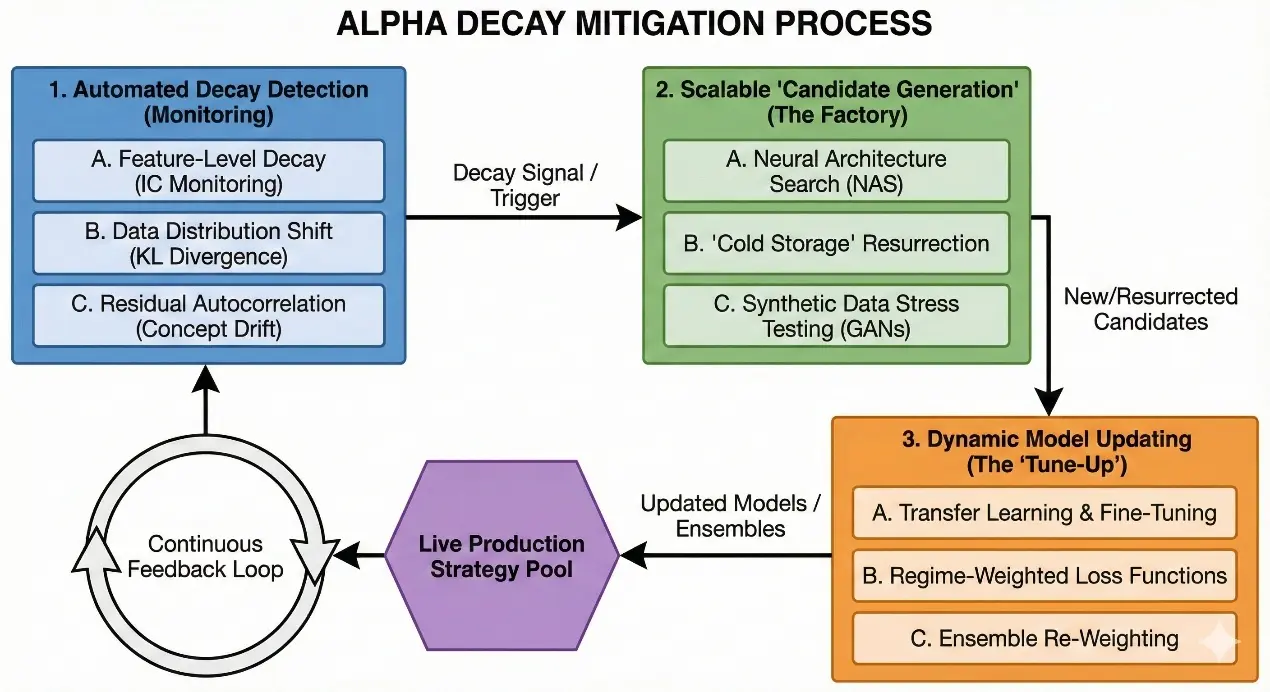
1. Automated Decay Detection (The "Check Engine" Diagnostics)
We do not wait for PnL to drop to detect decay. PnL is a lagging indicator. We monitor leading systemic indicators that suggest the model involves a relationship that no longer exists.
A. Feature-Level Decay (Information Coefficient Monitoring)
Before the model fails, the inputs usually fail. We track the Information Coefficient (IC) of key factors.
- Metric: Rolling Rank Information Coefficient (RankIC) between the factor value at t and the return at t+k.
- Decay Trigger: If the 14-day moving average of the IC drops below a statistical threshold (e.g., $IC < 0.02$) or the IC Volatility spikes, the factor is flagged as "Broken".
B. Data Distribution Shift (Covariate Shift)
Models train on a specific distribution of data. If the market microstructure changes (e.g., volatility doubles, or liquidity creates new patterns), the input data distribution shifts, making the model's learned weights invalid.
- Test: Kullback-Leibler (KL) Divergence or Population Stability Index (PSI).
- Logic: We compare the histogram of input features from the Training Set vs. the Last 24 Hours.
- Threshold: A high KL divergence score indicates the model is essentially "blind" because it is seeing data it never studied.
C. Residual Autocorrelation (Concept Drift)
- Logic: In a healthy model, errors (residuals) should be random white noise.
- Decay Signal: If the model's errors start showing Serial Autocorrelation (e.g., the model consistently under-predicts 5 times in a row), it implies there is a new structured signal in the market that the model is missing. The "Alpha" has moved into the "Residuals."
2. Scalable "Candidate Generation" (The Factory)
This module runs constantly in the background on the HPC cluster. It does not trade; it exists solely to create a "Bench" of replacement strategies ready to be subbed in.
A. Neural Architecture Search (NAS)
Instead of a researcher manually picking a model, we use compute to search for the best topology
Search Space: The system iterates through combinations of:
- Base Models: LSTM vs. GRU vs. Transformer (TFT) vs. TCN (Temporal Convolutional Network).
- Hyperparameters: Hidden dimension size, attention heads, dropout rates.
Optimization: We use Bayesian Optimization (TPE) rather than random grid search. The system "learns" which architectures perform best for specific assets (e.g., "ETH pairs prefer Transformers, but Alt-coins prefer GRUs").
B. The "Cold Storage" Resurrection
Alpha often cycles. A strategy that decayed in 2022 might be profitable in 2025.
Process: Decayed models are not deleted; they are moved to a "Hibernation" pool.
Continuous Re-Evaluation: The system runs a lightweight backtest on these hibernated models using the most recent data every week. If a "dead" strategy suddenly shows a Sharpe > 2.0 on recent data, it is promoted back to the "Active Candidate" list.
C. Synthetic Data Stress Testing
To ensure new candidates aren't just overfitted to the last month of data, we train them on GAN-generated market data.
Method: A Generative Adversarial Network (GAN) creates synthetic price paths that mimic the statistical properties of the asset but contain "extreme scenarios" (crashes, liquidity voids).
Selection: Only candidates that survive the synthetic stress test are eligible for deployment.
3. Dynamic Model Updating (The "Tune-Up")
Sometimes replacing a model entirely is expensive. Often, we just need to adjust it to the current regime.
A. Transfer Learning & Fine-Tuning
The Base: We maintain a massive "Foundation Model" trained on 5 years of data across all assets. This learns universal truths (e.g., "volume spikes often precede volatility").
The Head: When a specific asset's alpha decays, we freeze the Foundation Model layers and only retrain the final output layers (The Head) on the most recent 3 months of data.
Benefit: This requires 1% of the compute of full training but adapts the model to recent market behavior almost instantly.
B. Regime-Weighted Loss Functions
When retraining strategies, not all data is equal. We want the model to prioritize data that looks like today.
Mechanism: We use the Regime Detection module (WKMeans/HMM) to classify historical data.
During training, then we weight the loss model according to the regime.
Result: If today is a "High Volatility Bear Market," the model effectively ignores data from "Low Volatility Bull Markets" during its update, optimizing strictly for the current environment.
C. Ensemble Re-Weighting (The Committee Vote)
In certain strategy configurations, instead of relying on one model, we run an Ensemble of models (e.g., one short-term trend, one mean reversion, one volatility spike). This typically would require specific rationale for activating ensemble re-weighting and is not used for typical strategies.
Mitigation: When alpha decays, it usually affects one specific style.
Action: We use a Gating Mechanism (a meta-model) that dynamically adjusts the voting weight of each sub-model based on its recent performance.
Outcome: If the "Trend" model starts failing, its weight is reduced to zero automatically, while the "Mean Reversion" model's weight is increased. The "System Alpha" remains robust even if individual "Component Alpha" decays.
V. Quantitative Trading Infrastructure and Compute Resources
Computational resources for AlphaNet is provided by Tensor and Phoenix SkyNet Node Network – below is an overview of the hardware used.
As an example, to compute 60+ asset-specific strategies with this level of complexity (Deep Learning + DRL + LLM Logic) requires a Tiered High-Performance Computing (HPC) Architecture. You cannot throw everything onto GPUs. The "Search" phase (training) and the "Live" phase (inference) have diametrically opposite needs.
1. Compute Architecture Breakdown
1. Hybrid Alpha Factory (Logic Generation)
Compute Type: GPU (Inference Optimized)
Workload: The LLM generates code snippets (formulas). This is a "bursty" workload (you generate a batch of ideas, then stop to test them).
Hardware: NVIDIA A100 (80GB) or H100.
- Why: To run a high-quality coding LLM model with sufficient context window, you need massive VRAM. Consumer cards (RTX 4090) will choke on the context length required to read API docs and write complex Polars code.
2. DRL Factor Builder (The "Search" Engine)
Compute Type: High-Core CPU (Primary) + Mid-Range GPU (Secondary)
Workload: The DRL agent (PPO) interacts with the environment.
- The Bottleneck: Environment Simulation. Calculating the PnL of a formula across 5 years of tick data for 60 assets is a CPU-bound serial task.
Hardware: Dual AMD EPYC (96+ Cores) or Threadripper.
Why: You need massive parallelism to simulate 60 environments simultaneously. The GPU is only used to update the small Neural Network policy (a few milliseconds), while the CPU spends seconds simulating the trade.
Rule: Ratio of 1 GPU : 64 CPU Cores.
3. Denoising & Feature Processing (FracDiff)
Compute Type: GPU (CUDA Kernels)
Workload: Matrix operations on massive time-series arrays (10^9 data points).
Hardware: NVIDIA RTX 6000 Ada or A6000.
- Why: Standard CPU loops for Fractional Differentiation are too slow. A custom CUDA kernel can speed this up by 400x. We prioritize FP32 throughput here over the Tensor Cores needed for AI.
4. Base Prediction Model (Training)
Compute Type: GPU (Tensor Core Optimized)
Workload: Training Transformers/LSTMs. This is pure matrix multiplication.
Hardware: Cluster of NVIDIA H100s, A100s, Alibaba PPU, or Huawei 910C
Why: Training 60 separate asset models with a Transformer architecture is heavy. If you perform "Walk-Forward Validation" (retraining the model every week on expanding windows), you effectively train thousands of models.
Optimization: Use Mixed Precision (FP16) to double throughput.
5. Signal Processing & Execution (Inference)
Compute Type: High-Frequency CPU
Workload: Particle Filtering and Execution Logic.
Hardware: Overclocked Intel Core i9 (5.5GHz+) or AMD Ryzen 9.
- Why: Latency. Moving data from RAM to GPU memory and back takes microseconds (PCIe bottleneck). For execution logic involving if/else statements and Particle Filters (which are sequential Monte Carlo methods), a fast CPU beats a GPU.
2. The "Combinatorial Explosion": Why You Need This Power
You asked why such a pipeline produces a "myriad of versions" requiring this compute. This is known as the Curse of Dimensionality in System Design.
In a traditional regression model, you fit Y = mX + b. In this pipeline, every single arrow in your diagram represents a Search Space.
1. The Time Horizon and Feature Set Multiplier (20x – 30x Load)
You cannot train one model. You must train specific versions for specific time horizons and feature sets.
Standard: Train Model A.
Robust: Train Model A1 (1H horizon, Feature Set A) Model A2 (2H horizon, Feature Set B) …. A_N
Result: Your 60 assets just became 1200+ models to train and maintain.
2. The Hyperparameter Grid (The "Grid Search" Tax)
In theory hyperparameter optimization only done on a non-granular scale (overoptimization causes problems). But overall deep Learning models are notoriously sensitive. For each of the 60 assets, the system must automatedly test (Example):
Learning Rates: [1e-3, 1e-4, 5e-4]
Lookback Windows: [50, 100, 200]
Dropout Rates: [0.1, 0.3, 0.5]
Result: 3 x 3 x 3 = 27 variations per asset per model.
3. Walk-Forward Cross-Validation (The "Time" Tax)
In markets, you cannot train on 2022 and test on 2023 once. You must perform Rolling Window Backtesting.
Train Jan-Mar, Test Apr.
Train Feb-Apr, Test May.
Train Mar-May, Test Jun.
Result: This multiplies your compute requirement by the number of "Folds" (e.g., 52 weeks in a year).
Summary Table: The Compute Bill
| Module | Primary Hardware | Role | Why? |
|---|---|---|---|
| Logic Gen (LLM) | GPU (High VRAM) | Code Generation | Requires 80GB+ VRAM for 70B parameter models. |
| Alpha Search (DRL) | CPU (High Core) | Simulation | Simulating 10 years of tick data is CPU-bound. |
| Denoising | GPU (CUDA) | Matrix Ops | 400x speedup for fractional differencing vs CPU. |
| Model Training | GPU (Tensor Core) | Deep Learning | Massive parallel matrix multiplication for Transformers. |
| Signal/Exec | CPU (High Clock) | Sequential Logic | Avoid PCIe latency; sequential math is faster on CPU. |
VI. Overfitting Mitigation for Automated Trading Systems
For many quant trading firms that are not predominantly using deep learning – one of the major concerns is model overfitting. AlphaNet has a particular process in place for overfitting and we refer to it as an Adversarial Validation Gate.
In standard deep learning, overfitting mitigation happens during training (dropout, regularization). In institutional quantitative trading, that is insufficient because financial data is non-stationary. A model can be perfectly regularized on 2018-2022 data and fail spectacularly in 2023 because it overfit to the regime structure of the past.
This proposed mechanism sits after model training and before paper trading. It is a torture chamber designed to break the model by attacking its specific weaknesses related to parameter brittleness and regime dependency.
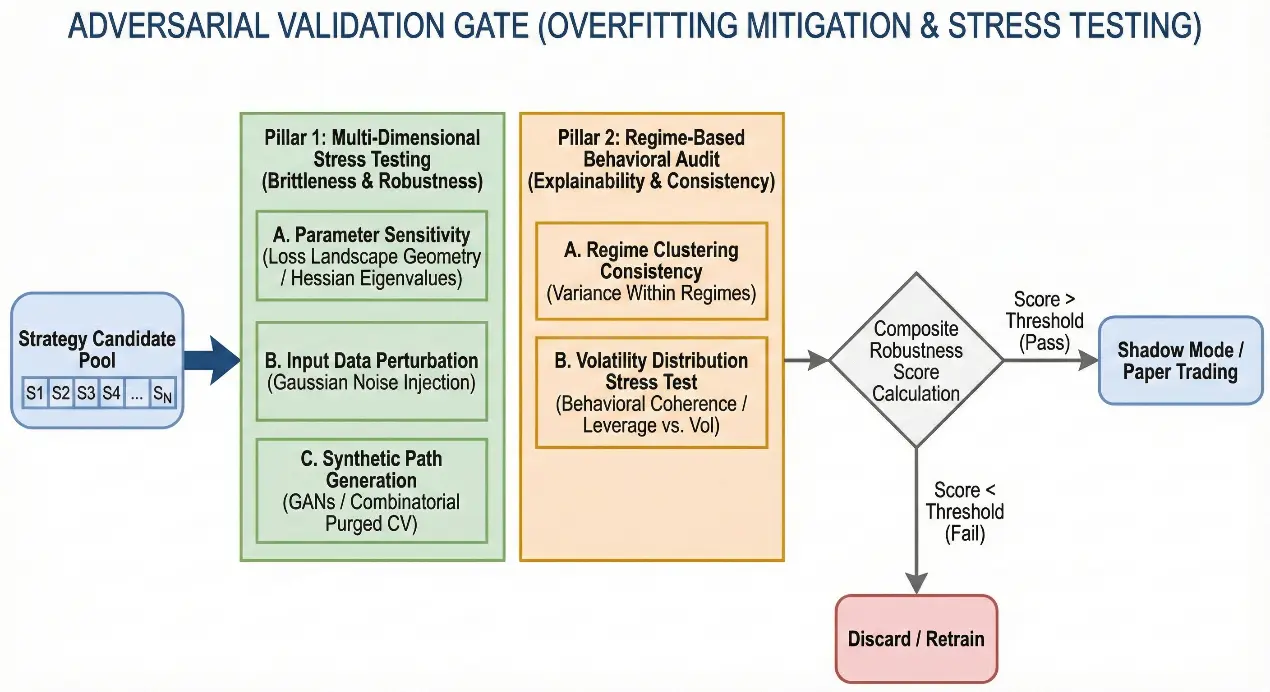
The Architecture: The Adversarial Validation Gate
This module takes a trained "candidate model" (weights frozen) and subjects it to a battery of tests that measure its Generalization Gap not just in time, but in parameter space and regime space.
Pillar 1: Multi-Dimensional Stress Testing (The "Brittleness" Test)
Overfitted models in finance are often "brittle," meaning their performance collapses under slight perturbations of inputs or configurations. We test stability across three dimensions.
A. Parameter Sensitivity Surfaces (The Loss Landscape Geometry)
Instead of just picking the best hyperparameters, we analyze the shape of the performance surface around the chosen parameters.
Concept: A model located in a "sharp minimum" of the loss landscape is overfitted; a slight shift in data distribution will push it up the steep walls, exploding the error rate. A model in a "flat minimum" is robust.
Mechanism (Local Sensitivity Analysis):
- Take the optimal trained model configuration C.
- Define an n-dimensional hypersphere around C representing slight perturbations (±5%) of critical parameters (e.g., Lookback window size, EMA smoothing decay, regularization strength lambda).
- Run 500+ backtests sampling random points within this hypersphere.
The Test: Calculate the Hessian Eigenvalues of the performance metric surface.
Pass Criteria: The surface must be smooth and relatively flat. If the largest eigenvalue is too high (indicating a very steep curvature, or a "needle-in-a-haystack" solution), the model fails.
B. Input Data Perturbation (Adversarial Robustness)
An overfitted model often relies on highly specific, minute feature combinations to make predictions.
Concept: If adding imperceptible noise to the input prices flips the model's trading signal from "Strong Buy" to "Strong Sell," the model is reacting to noise, not structural signal.
Mechanism (Gaussian Noise Injection):
- Take real historical feature data X.
- Generate perturbed data in that the noise magnitude should be smaller than the average bid-ask spread (sub-microstructure noise).
- Compare model predictions f(X) vs f(X').
Pass Criteria: The correlation between predictions on clean vs. noisy data must be > 0.95. The model's output should be stable against sub-tick noise.
C. Synthetic Path Generation (GANs/Bootstrap)
History is just one sample path. Overfitting is often just optimizing for that specific historical sequence of events.
Mechanism (Combinatorial Purged Cross-Validation - CPCV):
Divide history into $N$ granular blocks (e.g., weeks).
Generate thousands of synthetic historical paths by recombining these blocks in random orders (while purging data at the boundaries to prevent leakage).
The Test: Run the model on these thousands of synthetic histories.
Pass Criteria: The distribution of Sharpe Ratios across synthetic paths must not have a massive left tail. We measure the Probabilistic Sharpe Ratio (PSR). If the model only works on the actual historical path but fails on 90% of recombined paths, it is overfitted to luck.
Pillar 2: Regime-Based Behavioral Audit (The "Explainability" Test)
In trading, "explainability" does not mean looking at SHAP values to see that "P/E ratio mattered." It means the model's behavior must be predictably consistent across similar economic conditions. If it is not, it has learned spurious context.
A. Regime Clustering Consistency Check
Prerequisite: The pipeline's Regime Detection module (using WKMeans or HMM, as established previously) has for (in one random example regime’s case) classified history into clusters: e.g., Regime 1 (Low Vol Bull), Regime 2 (High Vol Mean Reversion), Regime 3 (Liquidity Crisis).
Mechanism:
Identify disjoint time periods that belong to the same cluster (e.g., Q2 2014 and Q1 2019 might both be Regime 1).
Evaluate the model's performance metrics (Win Rate, Avg Profit/Trade, Holding Period) separately for these disparate but stylistically similar periods.
The Test (Variance of Behavior): Calculate the variance of key metrics within the same regime cluster across different times.
Pass Criteria: Low internal variance. If a model has a 60% win rate in 2014's bull market but only a 45% win rate in 2019's bull market, it has overfitted to 2014's specific idiosyncrasies, not the general concept of a "bull market."
B. Volatility Distribution Stress Test
A robust model should exhibit coherent behavior relative to market volatility.
Mechanism:
Bucket historical data into volatility deciles (from lowest 10% realized volatility to highest 10%).
Calculate the model's average Gross Leverage and Turnover within each decile.
The Test (Behavioral Coherence):
Expectation 1: As volatility increases into the highest deciles, model leverage should generally decrease (or at least stay flat). A model that increases leverage during massive volatility spikes is likely overfitted to a few lucky outlier events in training.
Expectation 2 (The "Panic" Check): In the highest volatility percentile (crises), does the model's trading frequency explode? Overfitted models often "thrash" (rapidly buy/sell) during noise regimes they don't recognize.
Pass Criteria: A monotonic (or logically explainable) relationship between market volatility buckets and model risk-taking behavior.
VII. AI Algorithmic Order Execution
Reducing slippage and trading costs, and increasing execution efficiency and automation by providing users AI-powered (DL/DRL) algorithmic execution is one of the key offerings of AlphaNet.
Many quants when they think of algorithmic execution they first think of mathematical or statistical models of execution that many of the big banks have used stably for many years. This analysis details the shift from traditional "Schedule-Based" (stochastic control) execution (Almgren-Chriss algorithm being one of the more popular) to "Adaptive" execution (Deep Learning/DRL) and the infrastructure required to support it.
1. Why Deep Learning Execution is Superior to Almgren-Chriss (AC)
For a detailed comparison of execution methods, see Dynamic TWAP Optimization: Almgren-Chriss Stochastic Control vs Reinforcement Learning.
The traditional Almgren-Chriss (2000) model treats trading as a convex optimization problem: minimize cost (market impact) subject to a risk aversion penalty (volatility). While elegant, it fails in many modern markets for three specific reasons that DL/DRL solves:
A. Non-Linearity & Cross-Impact (The "Realism" Gap)
Traditional (AC): Assumes market impact is linear (selling 2x volume moves price 2x) and temporary/permanent split is constant. It views the asset in isolation.
Deep Learning: Markets are non-linear. The "Market Impact Surface" changes based on liquidity depth.
DL Advantage: A Neural Network can learn that selling 100 lots when the Order Book is "skewed bid-side" has zero impact, but selling 100 lots when the book is "flat" causes a crash.
Cross-Impact: DL models (especially Graph Neural Networks or Transformers) can look at correlated assets (e.g., "BTC is dumping, so ETH liquidity will vanish in 50ms") and adjust execution before the impact hits the target asset.
B. Microstructure Awareness (The "Alpha" Gap)
Traditional (AC): Traditional implementations of AC are "blind" or limited to the Limit Order Book (LOB) microstructure. It only cares about Volatility and Time. It executes on a schedule regardless of whether the spread is 1 tick or 10 ticks.
Deep Learning: Uses Level 2-3 Data (Order Queue) as inputs.
- Smart TWAP: Instead of blindly buying every minute, a DL-TWAP agent observes the Order Book Imbalance (OBI). If there is huge selling pressure, it pauses (waits for the dip). If there is buying pressure, it aggressively joins the bid. It targets "Passive Fills" (earning the spread) rather than "Aggressive Takes" (paying the spread).
C. Adaptability to Regimes (The "Stiffness" Gap)
Traditional (AC): Parameters like "Risk Aversion" are static constants set by the trader before the trade starts.
Deep Reinforcement Learning (DRL): The agent learns a policy P that maps the current state to an action.
- Scenario: If volatility spikes from 10% to 50% mid-trade, AC continues its pre-calculated curve, potentially getting slaughtered. A DRL agent immediately recognizes the "High Volatility" state and switches behavior (e.g., dumping faster to reduce inventory risk), dynamically mimicking the behavior of a skilled human trader.
2. Compute & System Architecture for DL Execution
Unlike the Alpha Generation pipeline (which runs offline), Execution Algos must run in Real-Time (Online Inference) with low latency.
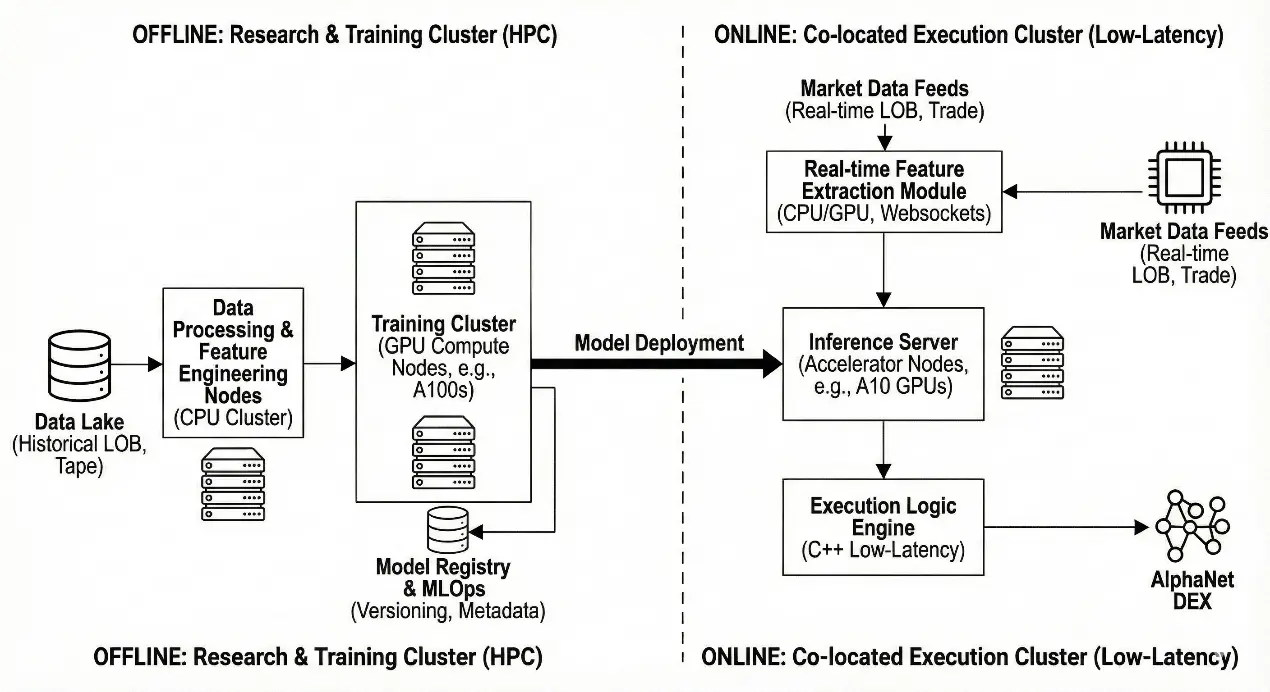
A. The Training Environment (Offline)
You cannot train DRL agents on live markets (too expensive). You need a High-Fidelity Simulator.
Compute: Massive CPU Clusters (e.g., 256+ cores).
The Engine: A Multi-Agent Simulator (like ABIDES) or a Historical Replay engine with "simulated impact."
Process: The DRL agent plays millions of "trading games" against the simulator using historical LOB data. It learns to minimize Implementation Shortfall (IS).
B. The Inference Engine (Online / Co-located)
This is where the trained model lives. It must decide "Buy/Sell/Hold" in microseconds or single-digit milliseconds.
Hardware:
Inference Server: Co-located in the exchange data center (e.g., NY4, LD4).
Accelerator: NVIDIA T4 or A10 GPUs (optimized for INT8 inference) or FPGAs (Xilinx Alveo) running customized neural network IP blocks.
Software Stack:
TensorRT / ONNX Runtime: To optimize the trained PyTorch model for sub-millisecond inference.
C++/Go Wrapper: The core execution logic is C++. It calls the Python/TensorRT model only for the "decision," then executes the order via binary FIX/OUCH protocols.
C. Data Ingestion (The Fuel)
Input: Full depth LOB (Level 2), Trade Tape, and derived features.
Feature Engineering: Must happen on the fly (in memory). You cannot query a database. The FPGA or CPU constructs the tensor state (e.g., [Last_50_Ticks, Volume_Profile, Current_Inventory]) to feed the model.
3. Comparison: Traditional vs. Deep Learning Algos
The following table contrasts the classical approach (Almgren-Chriss/VWAP) with the modern DL/DRL equivalents.
| Feature | Traditional (Almgren-Chriss / Static VWAP) | Deep Learning / DRL Enabled |
|---|---|---|
| Mathematical Basis | Closed-form Convex Optimization (Calculus). | Markov Decision Process (MDP) / Deep Neural Networks. |
| Input Data | Price, Volatility, Volume, Time. | Full LOB (L2/L3), Order Flow, Microstructure features, Latent States. |
| Market Impact | Assumed Linear or Square Root law. Constant. | Learned Non-Linear surface. Dynamic based on liquidity depth. |
| Schedule | Pre-determined (Static Curve). "I will buy 10% every 15 mins." | Dynamic Policy. "I will buy when probability of price increase > 70%." |
| Spread Capture | Generally ignores bid-ask spread (assumes mid-point). | Active Spread Capture. Learns to post limit orders to earn rebates. |
| Adaptability | Rigid. Fails during "Flash Crashes" or regime shifts. | Adaptive. Recognizes "Toxic Flow" and halts or accelerates accordingly. |
| Compute Cost | Negligible (can run on a calculator). | High. Requires GPUs for training and low-latency inference servers. |
| Key Weakness | Predictable (predatory HFTs can "sniff out" a VWAP algo). | "Black Box" risk (harder to explain why it paused trading). |
Specific Algo Variations
DL-TWAP: Dynamic TWAP is used when the entire block of trade needs to be executed in a timely manner with minimal costs (as in short timeframe trading strategies) Instead of "Time Slicing" (buy every minute), it performs "Smart Pacing." It tracks the Micro-Price (volume-weighted mid-price). If Micro-Price deviates significantly from Mid-Price (indicating pressure), it adjusts the slice timing to get a better fill. Advanced TWAP algorithms also have adept short-timeframe price drift prediction models to capitalize on pacing not just by detecting liquidity opportunities but potential price direction in the next timeframe.
*DL-VWAP: Traditional VWAP assumes the "Volume Smile" (U-shape) is the same every day. Deep VWAP uses an LSTM/Transformer to predict today's specific volume curve based on the first 30 minutes of trading, avoiding the trap of trading too heavily on a low-volume day. VWAP is good for pure-maker orders, offloading trades or building trades that are not time sensitive with minimal market impact (suitable for trades >6 hours to days).
Deep Implementation Shortfall (Hybrid): This is the ultimate DRL agent. It has two competing internal rewards:
Urgency (TWAP-like): "Finish the trade before the close."
Cost (VWAP-like): "Don't move the price." The DRL agent dynamically weights these based on real-time volatility. If the market is quiet, it acts like VWAP. If the market starts crashing, it switches to "Urgency Mode" to liquidate immediately.
Summary of Behavioral Differences
DL-TWAP is the "Stealth Operative". It doesn't care if the price is going up or down; its only job is to be invisible and finish on time. The Deep Learning here is focused on camouflage and micro-timing.
DL-VWAP is the "Follower". It mimics the crowd. If the crowd trades, it trades. If the crowd sleeps, it sleeps. The Deep Learning here is focused on forecasting the crowd's behavior.
DL-Hybrid (Implementation Shortfall) is the "Trader". It has an opinion. If it senses danger (high volatility), it panics effectively. If it senses safety, it acts patiently. The Deep Learning here is focused on strategic decision making under uncertainty.
For more an even deep-dive on the different various model implementations of deep learning algo execution models, refer to this technical paper by the Tensor team and head of AI Jimmy:
Link: [link to paper]
END OF TECHNICAL WHITEPAPER